Identity Access & Control
Secure identity and access management across your organization.
Manage authentication, authorization, role assignments, delegation and access visibility across AssuriCore modules.
Identity Access & Control provides the security and role-management foundation for AssuriCore. It helps organizations control who can access the platform, which modules they can use, what permissions they receive and which operational responsibilities apply to them. Instead of relying on broad, inherited roles that create too many tasks, emails and permissions, users can be linked to the specific work units, groups or organizational areas they are actually responsible for. Revolutionary stuff, apparently: people should only get access to what they need.
Home > Identity Access & Control
Why
Access control should create clarity, not permission sprawl.
In assurance environments, access is not just about logging in. It determines what people can see, what they can do, which tasks they receive and which decisions they are expected to support. When role assignments are too broad, users receive access, tasks and notifications for areas they are not responsible for. That creates noise, confusion and unnecessary risk.
-
Central user and role management.
-
Secure intranet and extranet authentication.
-
Role-based authorization across modules.
-
Fine-grained responsibility assignment.
-
Clear hierarchy-based access control.
-
Delegation for business continuity.
-
Read-only permission matrix.
-
Usage tracking for access review and reporting.
Challenges
Broad role assignments create too much access, too many tasks and too little transparency.
When roles are assigned too high in an organizational hierarchy, users can inherit permissions across too many work units. That leads to excessive task lists, unnecessary email notifications and unclear ownership. External access adds another layer of complexity, because administration functionality must remain protected while legitimate contractors still need controlled access to the platform.
-
Role assignments are often not fine-grained enough.
-
Users may receive tasks and emails for units they do not manage.
-
Mobile and external access can become difficult to control.
-
User access and operational crew management should not be mixed.
-
Contractors, work units, locations and organizational units need different access rules.
-
Administrators need visibility into who has which role, where and why.
-
Access reviews require reliable usage and role information.
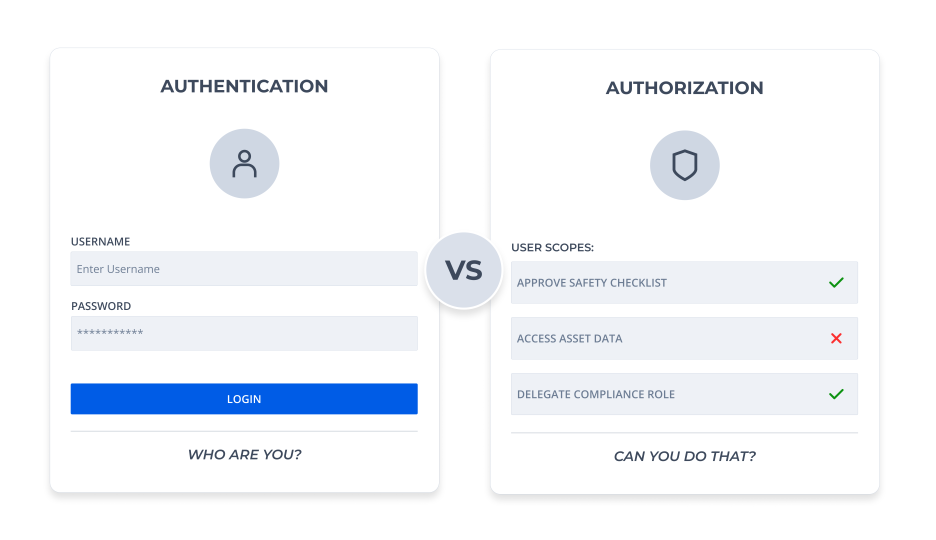
The solution
A secure identity and access layer for the full AssuriCore platform.
Identity Access & Control centralizes authentication, authorization, user management, role assignment and delegation. Users authenticate through the correct access path, while authorization checks determine whether they may access the requested portal module. Roles define permissions, responsibilities, user tasks, notifications and where those roles may be assigned in the hierarchy.
How it works
From secure login to controlled role-based access.
Identity Access & Control follows a structured flow that authenticates users, checks authorization, applies role rules and gives administrators a clear way to manage access across the platform.
1.
Authenticate the user.
Users access AssuriCore through the appropriate internal or external authentication route, including intranet authentication or extranet authentication through Azure Active Directory / Entra ID.
2.
Check module authorization.
The system checks whether the user has a role that grants access to the requested module or scope.
3.
Assign roles by hierarchy.
Administrators assign roles at system, contractor asset or organizational hierarchy level, depending on where the role applies.
4.
Link responsibilities.
Specific operational roles can be linked to the work units or work unit groups for which the user is actually responsible.
5.
Review and govern access.
Administrators can review roles, permissions, delegates and usage information to keep access clean, traceable and aligned with responsibility.
1.
Authenticate the user.
Users access AssuriCore through the appropriate internal or external authentication route, including intranet authentication or extranet authentication through Azure Active Directory / Entra ID.
2.
Check module authorization.
The system checks whether the user has a role that grants access to the requested module or scope.
3.
Assign roles by hierarchy.
Administrators assign roles at system, contractor asset or organizational hierarchy level, depending on where the role applies.
4.
Link responsibilities.
Specific operational roles can be linked to the work units or work unit groups for which the user is actually responsible.
5.
Review and govern access.
Administrators can review roles, permissions, delegates and usage information to keep access clean, traceable and aligned with responsibility.
Product experience
Designed around visibility, control and auditability.
The interface gives administrators a clear view of users, roles, hierarchy locations, responsible assets and permissions. The goal is simple: make access understandable before someone accidentally grants half the organization the keys to the kingdom.

Core capabilities
Everything needed to manage secure platform access.
Identity Access & Control combines authentication, authorization, role management, delegation and usage tracking into one controlled access foundation for AssuriCore.

Automatic role assignment.

Flexible role assignments.

Delegation & proxy access.

Azure AD / Entra ID integration.

Role-based access control.

User and role management.

Restricted impersonation.

Usage tracking & reporting.

OAuth2 authorization.

Permission matrix.

Access governance.

Secure authentication.
Benefits
What this means in practice.
Identity Access & Control helps organizations reduce access noise, strengthen governance and create a clearer link between users, roles and operational responsibility.
Less permission noise.
Users receive access, tasks and notifications based on actual responsibility, not vague hierarchy inheritance.
Stronger security control.
Sensitive user and role administration can be restricted to authorized users and internal access paths.
Better operational continuity.
Delegation helps workflows continue when key users are unavailable, without losing traceability.
Clearer access reviews.
Usage tracking and role visibility make it easier to review whether users still need their current access.
Less permission noise.
Users receive access, tasks and notifications based on actual responsibility, not vague hierarchy inheritance.
Stronger security control.
Sensitive user and role administration can be restricted to authorized users and internal access paths.
Better operational continuity.
Delegation helps workflows continue when key users are unavailable, without losing traceability.
Clearer access reviews.
Usage tracking and role visibility make it easier to review whether users still need their current access.
Who it's for
Built for organizations that need access control they can actually explain.
Identity Access & Control is designed for teams that need secure, role-based access across assurance workflows, operational modules and contractor-facing environments.

Portal administrators.

System owners.

IT security teams.

HSE and assurance teams.

Compliance reviewers.

Organizations managing internal and external access.

Well engineering teams.

Contractor coordinators.

Application support teams.
Built with control
One access model. Multiple secure modules.
The module uses a centralized identity and role-management approach where authentication, authorization, role definitions and responsibility assignments support the wider AssuriCore platform. Access decisions are based on configured roles, module scopes and hierarchy context, helping keep permissions consistent across modules.
Component action.
-
Authenticate
-
Check role assignments
-
Validate module scope
-
Apply hierarchy and responsibility rules
-
Issue authorization token
-
Grant controlled module access
See how Identity Access & Control helps teams manage secure authentication, role-based permissions and operational responsibility across AssuriCore.
Make access easier to control, review and trust.